BACKGROUND
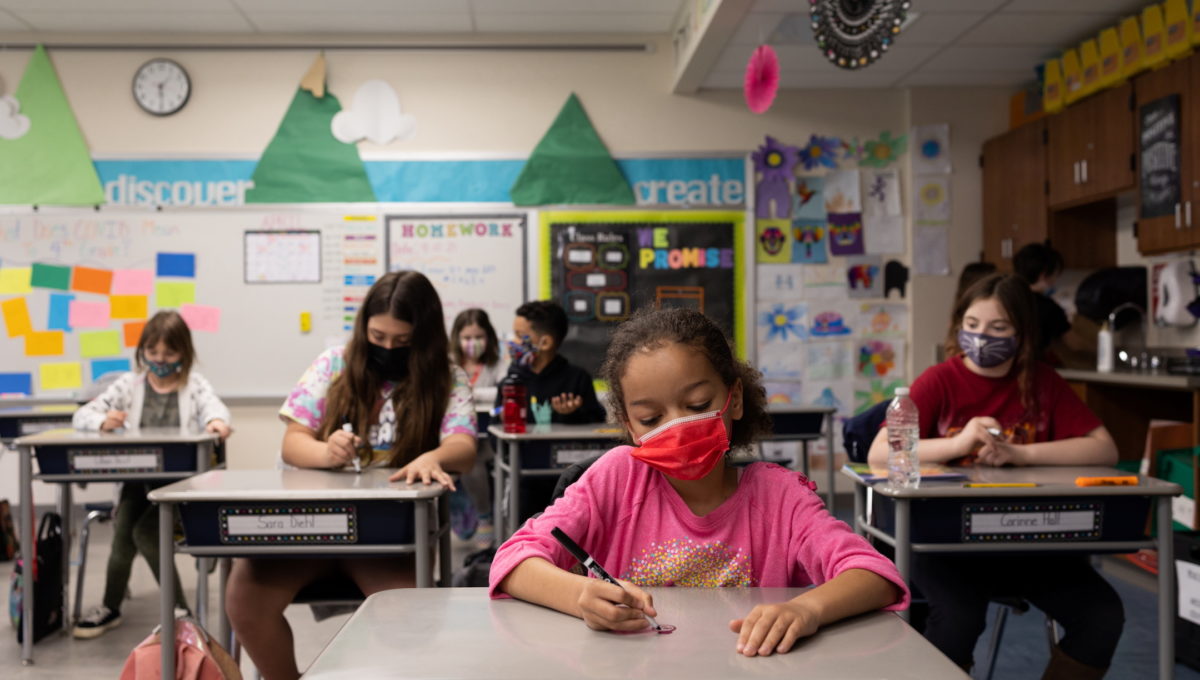
Photo Credit: Associated Press
Literature Review
The extant literature on COVID-19 highlights significant disruptions to student learning in the United States. Many scholars concur that COVID-19 exacerbated disparities in education. The pandemic disproportionately affected students from low-income families and historically marginalized groups (Bailey et al., 2021). Furthermore, lengthy school closures appear to be correlated with declines in standardized test scores (Middleton, 2020; Hough & Chavez, 2025; Jordan, 2022). One study, by Miles and Helmstetter, also seems to indicate that test scores have not returned to the levels that existed prior to the pandemic (Miles & Helmstetter, 2024). However, some contradictions also appear in the literature. While Miles and Helmstetter report that standardized scores are returning to pre-pandemic levels, others have indicated very small improvement (Hough & Chavez, 2025).
The literature frequently ignores other important educational outcomes like graduation rates, college enrollment, and student well-being in favor of concentrating only on standardized test results. For example, the pandemic’s impacts on social skills development and mental health are still little understood, despite being crucial to comprehending the entire extent of its consequences on student populations. Furthermore, there is a substantial knowledge vacuum about the long-term educational paths of impacted pupils, even though the majority of the research focuses on the immediate academic effects. Longitudinal research is necessary to ascertain whether the pandemic’s effects will result in long-term educational deficiencies or whether recovery efforts may effectively mitigate these effects over time.
Significance
This project is significant because it directly addresses critical questions about how educators can leverage the SEDA2023 dataset to create tailored strategies that meet the needs of diverse student populations, with a particular focus on states like California and Ohio. In many library resources we have encountered relating to education during the covid 19 pandemic, educational policy and schools’ response played a significant role in student learning outcomes. Examining two states that varied in covid 19 response will provide insight into the effect of policy on student performance, measured in math and english language arts test scores. We are working on this project because we want to find out how historical educational inequality is reflected in academic performance across states, so that we can help others understand the multifaceted impact of these disparities. By examining the reliance on standardized test scores in a post-pandemic context, we challenge traditional metrics of success and explore how these scores might overlook broader indicators of student learning and growth. Moreover, through analyzing achievement trajectories at the district level, this research seeks to determine the extent to which the pandemic has either exacerbated or mitigated pre-existing inequalities. Overall, our work aims to empower educators and policymakers with actionable insights, promoting a more equitable educational landscape where every student’s unique needs are recognized and addressed.